
by Rev. Mathilde Sabbagh
During this Advent season, we renew the Hope—a Hope for Peace, a Hope for Life. Advent is the time when the Church waits in expectation, not passively, but with courage and faith. For us in Syria, this hope is not abstract. It is the fragile yet resilient flame that has carried us through more than fourteen years of war, displacement, and trauma.
In these years, countless lives have been lost—many killed, others kidnapped and disappeared, and still more drowned in the deep waters of exile. Those who remain in Syria live with scars that are not easily healed: poverty, lack of education, fear, sickness, and the daily struggle for survival. Trauma has become part of our collective memory.
Personal Journey Through Violence and Fear
I myself have walked through stages of perplexity, where the call to stand firm was not always easy to fulfill. In 2012, my brother, a pastor serving in Idlib, was kidnapped. By God’s mercy, he was later released, but the shadow of that experience has never left us. Then, in 2016, on the very first day of my ministry—July 3rd—a rocket (an RPG) struck our home during clashes between Kurdish forces and the old government. I was inside with my mother and my uncle’s young children. The terror of that moment is indescribable. For a week, we hid in the bathroom, telling stories and playing cards to distract the children while rockets fell around us. I sang to them, over and over, the hymn “A Mighty Fortress is Our God.” Its words became our shield, calming trembling hands and fearful eyes. Such experiences do not simply pass. We may smile, make jokes, and give thanks that we survived, but deep within, the memories remain alive. They shape us, and they remind us of the fragility of life and the depth of God’s sustaining grace.
Challenges of Ministry
Violence was not the only challenge. From the beginning, I faced rejection as a woman pastor. Some clergy openly denounced me from their pulpits, using harsh words against both me and the Protestant church. Yet, others—though cautious—welcomed dialogue and recognized my pastoral identity. My own congregation needed time to accept me, not because I am a woman, but because I was young and the daughter of the very church I was now called to lead. Slowly, through vision, mission, and presence, they began to see me not only as a member but as their pastor. Serving a poor church brought its own trials. With only ten Protestant families, mostly elderly, the congregation was small and weary. Many young people had already left Syria in search of a better life. The church owned a school, built in 1936, but war and poverty left it financially broken and administratively chaotic.
The Ministry of Presence
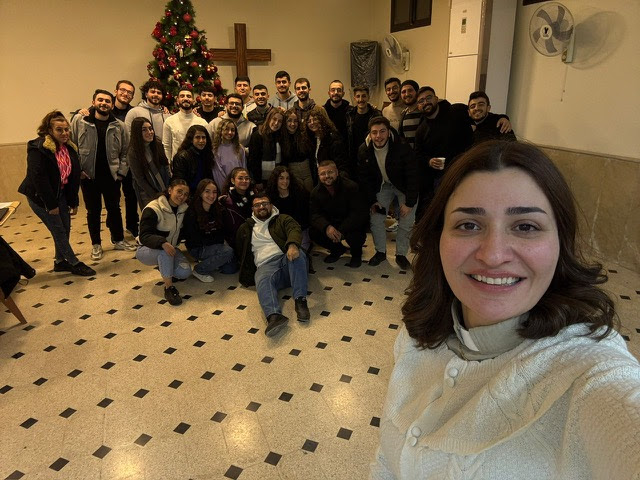
In response, I embraced what I call “The Ministry of Presence,” inspired by the Apostle Paul. I placed my office at the heart of the school, where I could interact daily with children and families. From there, I began new ministries: Sunday School, youth ministry, and women’s ministry.
Though small at first, these ministries grew. With patience, vision, and the principle of grace—“give though you need to be given, and God will multiply it”—we expanded into teenagers’ ministry, young mothers’ ministry, university groups, Bible studies, ecumenical trainings, and relief work for widows, orphans, and the needy. What began with a handful of people became hundreds, gathering with joy, expectation, and a desire to learn, share, and grow.
Current Struggles
Today, our challenges have shifted. In the summer of 2025, after the fall of the old regime, the Autonomous Administration of the northeast (SDF) attempted to close our private church schools or force us to adopt a Kurdish curriculum. This would have invalidated our students’ exams and stripped us of government recognition. For two months, negotiations dragged on. We stood united as churches, resisting pressure. Eventually, we secured an agreement to continue teaching the Syrian National Curriculum until May 2026, praying that further agreements will follow. Meanwhile, the presence of prisons for ISIS fighters and camps for ISIS women near our communities has heightened fear. Christians have faced kidnappings, land seizures, poverty, and forced military service. Since 2012, we have lived without electricity, relying on generators. Since 2019, after Turkey’s invasion of the Allouk water station, we have lived without running water. Pollution, poverty, and sickness—especially cancer—have risen sharply.
Our elderly are lonely and poor. Our youth are jobless and without prospects. Yet, in this bleakness, we continue to proclaim hope.
A Testimony of Faith
This is where I serve. I am Mathilde Sabbagh, the first female ordained pastor in Syria. I am a mother of twin girls, Michelle and Gretel, six years old, and we await the birth of our third daughter in February 2026. I serve the church and lead the school board, striving to renovate and renew both with the help of a faithful team trained over the past decade.
I hold a Bachelor’s degree in English Literature (Aleppo University, 2012), an M.Div. (N.E.S.T., 2016), and I am currently pursuing advanced studies in New Testament.
Through all of this, I cling to the Advent promise: that God’s light shines in the darkness, and the darkness cannot overcome it.
Closing Prayer
May God use us all to proclaim peace in the midst of war, hope in the midst of despair, and life among lands that seem dead. May our ministry of presence be a living testimony that Christ is born among us, even here, even now.